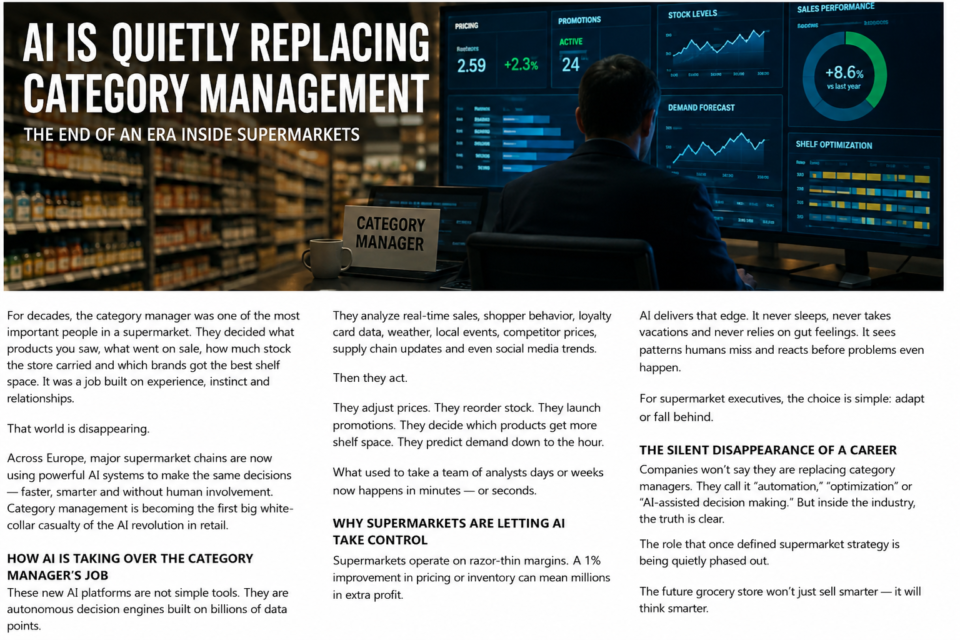
For decades, category managers were the hidden kings of the supermarket world.
They decided what you bought before you even entered the store.
They controlled the prices of cereal, the placement of milk, the promotions on frozen pizza, the discounts on Coca-Cola, and the shelf space given to global brands worth billions.
Inside retail headquarters, these people were treated like power brokers.
Now they are being quietly replaced.
Not by younger workers.
Not by outsourcing.
But by artificial intelligence systems that never sleep, never negotiate emotionally, and never stop learning.
Across Europe, major supermarket groups including Ahold Delhaize, Tesco, Carrefour, and Lidl’s parent company Schwarz Group are deploying a new generation of AI systems capable of handling pricing, replenishment, promotions, inventory forecasting, and shelf optimization with almost no human involvement.
The public still thinks supermarkets are run by experienced buyers and merchandising teams sitting in conference rooms arguing over sales reports.
That world is disappearing.
Fast.
What is happening now inside supermarket headquarters may become one of the biggest invisible white-collar labor revolutions of the AI era.
The Job That Built Modern Retail
Most people have never heard the phrase “category manager,” but the entire supermarket economy was built around them.
Each manager controlled a miniature empire.
One person might oversee yogurt. Another handled beverages. Another managed cleaning products. Another controlled snacks.
Their job was to predict human behavior before shoppers themselves understood it.
They analyzed:
- Consumer trends
- Supplier deals
- Seasonal demand
- Local buying habits
- Price sensitivity
- Competitor promotions
- Product performance
A good category manager could generate millions in additional profit.
A bad one could destroy margins across hundreds of stores.
For decades, supermarkets believed this work required instinct, experience, psychology, and human judgment.
Then AI arrived.
The New Machine Running the Supermarket
The systems replacing category managers are not simple chatbots.
They are massive decision engines connected to real-time streams of information flowing through every layer of the retail business.
The AI monitors:
- Every barcode scan
- Every loyalty card purchase
- Every online grocery search
- Every delivery delay
- Every stock shortage
- Every weather forecast
- Every competitor price change
- Every local economic signal
- Every social media food trend
The supermarket becomes a living data organism.
And the AI constantly adjusts it.
If a heatwave hits southern Europe, the system increases drink orders automatically.
If fuel prices rise, it pushes cheaper private-label products.
If TikTok suddenly makes pistachio cream trend overnight, the AI reallocates shelf space before human managers even notice demand exploding.
In some chains, these systems are already making pricing and promotional decisions every few minutes.
Humans used to work in weekly cycles.
The machine operates continuously.
The End of Human Delay
Supermarket executives discovered something uncomfortable:
The biggest weakness in retail decision-making was not intelligence.
It was human speed.
Human managers need meetings.
They debate.
They hesitate.
They wait for reports.
They rely on incomplete information.
AI does not.
An AI system can process billions of retail signals instantly and act immediately.
It can lower prices in Madrid, reduce avocado inventory in Amsterdam, launch a digital coupon campaign in Paris, and reroute warehouse shipments in Berlin at the exact same moment.
No human team can compete with that speed.
And once executives saw the numbers, the logic became ruthless.
Even tiny improvements in supermarket efficiency are worth enormous amounts of money.
A 1% pricing improvement can mean hundreds of millions in additional annual profit.
Reducing food waste by a few percentage points can save entire divisions.
The machine does not need to be perfect.
It only needs to be slightly better than humans.
Why Nobody Is Talking About It Publicly
The grocery industry is being extremely careful with its language.
Executives rarely say:
“AI is replacing category managers.”
Instead they use phrases like:
- AI-assisted merchandising
- Intelligent retail systems
- Commercial optimization
- Autonomous retail operations
- Decision intelligence
Because the truth sounds explosive.
This is not automation of warehouse labor.
This is automation of strategic commercial thinking.
And the implications reach far beyond supermarkets.
Suppliers Are Losing Their Human Advantage
For decades, giant consumer brands relied on personal relationships with category managers.
Sales executives from Coca-Cola, Nestlé, Unilever, and Procter & Gamble negotiated directly with humans who controlled shelf access and promotions.
Those relationships shaped the modern retail economy.
But algorithms do not care about personal history.
The AI only cares about measurable performance.
Margin.
Sales velocity.
Basket attachment.
Conversion rates.
Inventory turnover.
A machine has no loyalty to brands.
That changes the balance of power across the entire supermarket industry.
The Store of the Future
The future supermarket may look normal from the outside.
But behind the scenes, much of it could soon operate autonomously.
AI systems will decide:
- Which products survive
- Which prices rise
- Which brands get visibility
- Which promotions appear on your phone
- Which stores receive inventory first
- Which consumers receive personalized discounts
Human workers may remain inside the system.
But increasingly as supervisors.
Not decision-makers.
The category manager — once one of the most powerful people in retail — may slowly become obsolete.
Not through a dramatic collapse.
But through quiet irrelevance.
The Invisible Revolution
Most technological revolutions are loud.
This one is happening silently.
Customers still push shopping carts.
Shelves still look full.
Cashiers still scan products.
But somewhere inside a server room, algorithms are already making decisions once controlled by entire commercial departments.
And almost nobody outside the industry realizes how quickly the machine is taking over.
The supermarket was once powered by instinct.
Now it is being rebuilt around prediction.
And the people who once controlled the shelves are slowly losing control to systems that can think faster than they can react.
