
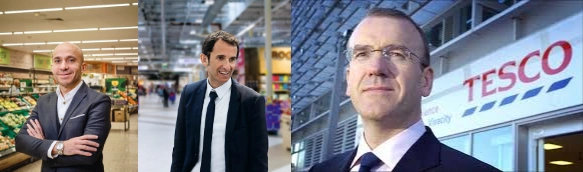
The story of grocery retail leadership over the past two decades is really a story about how far removed executives have become—or in some cases, how deliberately they’ve returned—to the shop floor.
During the era of Terry Leahy, retail leadership was often defined by disciplined corporate strategy, operational efficiency, and strong central control. Leahy’s tenure at Tesco became almost a blueprint for modern supermarket expansion: data-driven decisions, global ambition, and a tightly managed hierarchy. The CEO was powerful, but also somewhat distant from day-to-day customer interaction.
After that period, European retail began to evolve in different directions. At Carrefour, leadership under Alexandre Bompard marked a shift toward simplification and customer re-engagement. The focus moved away from pure scale toward experience, pricing clarity, and adapting stores to local expectations. It was less about abstract strategy and more about making stores feel relevant again.
What’s interesting in the current phase is that grocery CEOs are increasingly expected to be visibly present in stores—not just symbolically, but operationally. The modern retail leader is often photographed speaking with staff, walking aisles, and engaging directly with shoppers. This is not just PR; it reflects a recognition that grocery retail is intensely local and emotional, not purely logistical.
At Morrisons, leadership under Rami Baitieh has been associated with this more grounded style of management. The emphasis is on operational immersion—understanding pricing pressure, supply chain realities, and in-store execution from the customer’s perspective. Similarly, across the sector, executives are increasingly expected to appear at store openings, supplier visits, and community events, reinforcing the idea that retail leadership is not confined to boardrooms.
This shift also reflects pressure from multiple directions: thin margins, intense competition from discount retailers, and changing consumer expectations shaped by online shopping. In such an environment, credibility is no longer just about financial results—it’s about visibility and authenticity.
There is also a cultural shift at play. Where earlier CEOs were judged mainly on expansion and profitability, today’s retail leaders are also evaluated on trust, sustainability commitments, and employee morale. Being physically present in stores signals attentiveness to all three.
In that sense, grocery retail leadership has come full circle. It started with merchants who knew their stores intimately, evolved into corporate strategists managing vast networks, and is now returning—at least partially—to leaders who combine boardroom decisions with floor-level presence.
The result is a hybrid model: high-level strategic CEOs who are also expected to be recognizable, approachable figures within their own stores. Not just managing the business, but visibly participating in it.