
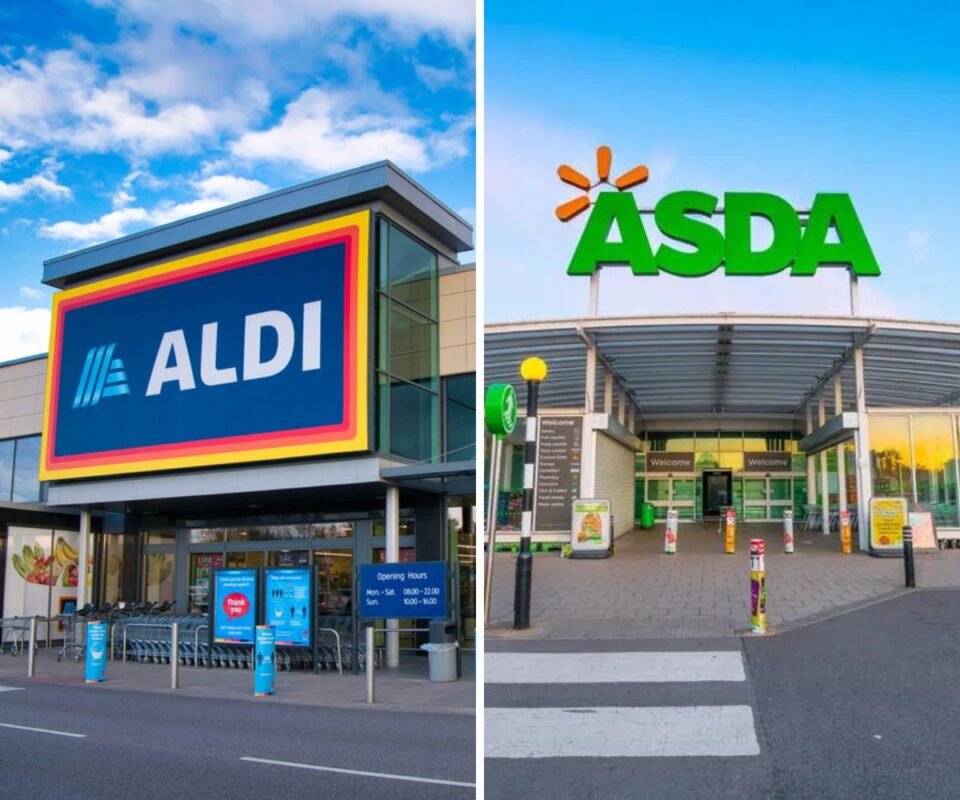
At the centre of this shift is Aldi, whose business model has fundamentally altered consumer expectations. Aldi does not compete on range, store experience, or convenience—it competes almost entirely on price efficiency.
That matters because it forces rivals into uncomfortable choices:
- Match Aldi prices and absorb thinner margins
- Or maintain pricing and risk long-term customer erosion
Asda’s decision suggests it has chosen the first option, and is now extending that logic deeper into its store network.
Why Express stores are the new battleground
Convenience stores were once one of the most profitable parts of supermarket operations. Higher prices were justified by proximity, speed, and smaller basket sizes.
But that model is weakening.
By applying price matching to Express locations, Asda is effectively rewriting the economics of convenience retail:
- The “convenience premium” is being reduced
- Price consistency is becoming more important than store format
- Shoppers are increasingly unwilling to pay more for proximity alone
In other words, convenience is no longer enough to justify higher prices—especially when discounters are within driving distance or even a short walk away.
The pressure behind the strategy
This shift is happening under broader economic strain. UK households are still highly sensitive to food inflation, and grocery loyalty has become more fragile than at any point in decades.
Three forces are driving supermarkets toward aggressive price alignment:
1. Discounters are no longer niche
Aldi and Lidl are no longer “budget alternatives”—they are mainstream competitors with national reach and strong brand trust.
2. Price perception matters more than price reality
Even small differences in staple goods can reshape shopping habits. Once a customer switches to a discounter, they rarely switch back without a strong incentive.
3. Basket economics are tightening
Shoppers are buying fewer discretionary items and focusing on essentials. That makes pricing on core goods disproportionately important.
The strategic risk for Asda
Price matching sounds defensive—but it carries a long-term cost structure challenge.
Extending Aldi parity deeper into the store network means:
- Lower margins across a larger footprint
- Increased pressure on operational efficiency
- Less flexibility in regional pricing strategies
This is not just a marketing decision—it is a structural commitment to competing on a discounter’s terms.
And that is the risk: discounters are designed to win on those terms.
The wider supermarket dilemma
The UK grocery sector is now split into two competing identities:
- Discounters: simplicity, efficiency, lowest price
- Traditional supermarkets: range, convenience, service, loyalty ecosystems
Asda’s expansion suggests those identities are converging. The distinction is blurring because survival increasingly depends on adopting discounter behaviour without fully abandoning supermarket infrastructure.
What this means for consumers
For shoppers, the immediate effect is straightforward:
- More essential items at lower, consistent prices
- Reduced price differences between large and small stores
- Less need to “shop around” for basics
But the long-term outcome is more complex. As pricing compresses across the sector, competition may shift away from price alone toward:
- Loyalty schemes
- Private-label expansion
- Store efficiency and automation
- Targeted promotions rather than broad discounts
A market being redefined in real time
Asda’s move is not an isolated tactic—it is part of a broader recalibration of UK grocery retail. The expansion of Aldi Price Match into thousands of stores reflects a simple reality: supermarkets are no longer setting the pace of pricing. They are reacting to it.
The discounters forced the first wave of change. Now, they are forcing a second: one where even convenience stores must behave like budget supermarkets.
And in that environment, the question is no longer who has the widest range or the nicest store.
It is who can hold the line on price—everywhere, all the time.