
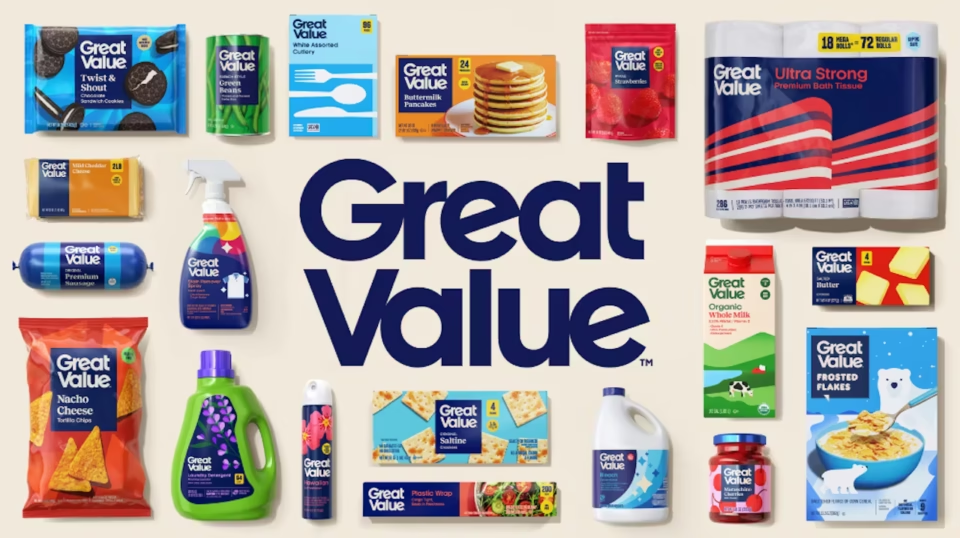
The decision by Walmart to modernise its flagship private label range marks a significant moment in the evolution of global retail branding. With its Great Value line touching the majority of American households, any change carries weight—not only for the retailer itself, but for the wider industry observing the next phase of private label competition.
However, from an International Supermarket News perspective, the move raises a more important question: is this a transformation, or simply a visual update?
A necessary but limited step
The refreshed packaging across Walmart’s core range is cleaner, more contemporary, and better aligned with current consumer expectations. In a market where design increasingly influences perception of quality, this step is both logical and necessary.
Yet, design alone does not define a successful private label strategy.
Across Europe, leading retailers have long understood that private label strength is built on three pillars: product quality, brand architecture, and consumer trust. Without these working in unison, even the most polished redesign risks lacking substance.
Tesco’s structural advantage
The comparison with Tesco is inevitable—and instructive.
Tesco has spent decades refining a tiered private label ecosystem that addresses all consumer segments:
- Entry-level value ranges for price-sensitive shoppers
- Core lines delivering consistency and reliability
- Premium offerings such as Finest, competing directly with branded goods
This structure is not accidental. It allows Tesco to control shelf space strategically while guiding consumer choice across price points. More importantly, it positions private label not as an alternative—but as a first choice.
Walmart, by contrast, continues to rely heavily on a dominant single-tier perception, where Great Value remains strongly associated with affordability rather than aspiration.
The missed opportunity in the US market
Private label penetration in the United States continues to grow, driven by inflationary pressure and changing consumer attitudes. However, it still lags behind European markets, where own-label products often command a significantly higher share.
For Walmart, this presents an opportunity—not just to grow margin, but to redefine consumer behaviour.
The retailer already possesses unmatched scale and distribution. What remains underdeveloped is a clear brand narrative that elevates its private label beyond price-led positioning.
Beyond packaging: the need for strategic clarity
From an ISN analytical standpoint, Walmart’s current approach appears incremental rather than transformational.
A redesign, while visible, does not address deeper strategic questions:
- Where is the clear segmentation between value, core, and premium tiers?
- How is product innovation being communicated to consumers?
- What investment is being made in marketing private label as a brand in its own right?
European retailers have demonstrated that consistent investment in storytelling and quality perception is essential to shifting consumer loyalty away from national brands.
Global implications
The importance of Walmart’s next steps extends beyond the United States. As international supply chains evolve and new manufacturing regions—particularly in North Africa and Asia—position themselves as competitive exporters, private label will play an increasingly central role in global retail strategy.
Retailers that master private label will not only improve margins but also gain greater control over sourcing, pricing, and consumer relationships.
ISN
Walmart’s private label refresh is a welcome development, but it stops short of the strategic ambition required to lead the sector globally.
Tesco’s model demonstrates that success lies not in redesigning packaging, but in building a coherent, multi-layered brand ecosystem supported by long-term investment.
For Walmart, the path forward is clear:
move beyond aesthetics and embrace private label as a core strategic asset, not simply a margin enhancer.
Only then can it fully capitalise on its scale—and reshape the competitive landscape of modern retail.