
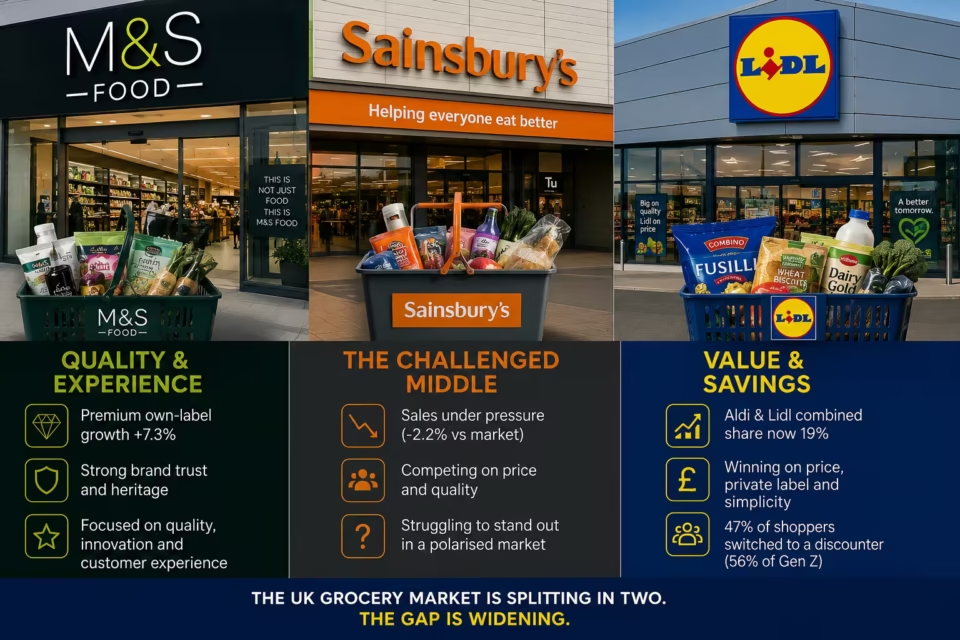
The UK grocery industry has crossed a threshold. What was once a broad, stable middle-market sector is rapidly splitting into two opposing forces: value at one end, premium at the other.
And increasingly, there is very little room in between.
The latest data paints a stark picture of a market being reshaped not by temporary inflation pressures, but by structural consumer behaviour that now appears deeply entrenched.
Own-label products have surpassed 50% of UK grocery volumes for the first time in history. In the very same month, premium own-label ranges broke through the £1 billion sales mark. Meanwhile, Lidl grew strongly enough to match Morrisons in market share — an unthinkable scenario just a decade ago.
This is no longer a single grocery market. It is a polarised one.
Growth Is Concentrated at the Extremes
The numbers reveal the scale of the transformation.
Discount leaders Aldi and Lidl now control a combined 19% share of the UK grocery market, up from just 8.5% ten years ago. Their rise has fundamentally altered pricing psychology across British retail.
At the opposite end of the spectrum, premium operators are also accelerating. M&S Food posted growth of 7.3%, Waitrose rose 7%, while Ocado surged 15% as affluent consumers continued spending on quality, convenience and differentiated products.
The pressure is falling squarely on the traditional middle ground.
Asda recorded a 3.3% sales decline and became the only major UK grocer to shrink during the Christmas trading period. Fitch downgraded the retailer amid mounting concerns over performance and leverage. Morrisons grew only 2.2%, roughly half the wider market rate.
The message from consumers is becoming unmistakable: shoppers are either trading down aggressively or trading up deliberately.
The middle proposition — “reasonable quality at a fair price” — is losing relevance.
The Rise of the K-Shaped Consumer
Economists increasingly describe the current environment as a “K-shaped economy,” where different income groups experience entirely different economic realities.
In grocery, the divide is especially visible.
Lower-income households now spend 14.3% of their income on food, compared with just 8.6% among more affluent consumers. As food inflation outpaces wage growth, shopper behaviour diverges sharply.
For financially pressured consumers, price has become the dominant decision-making factor. Nearly half of UK shoppers have already switched to a discounter, including 56% of Gen Z consumers.
But at the same time, wealthier households are not retreating from spending. Instead, they are becoming more selective and quality-driven. Remarkably, 92% of shoppers now purchase premium own-label products — a sign that premiumisation is no longer niche, but mainstream.
Consumers are not simply spending less or more. They are spending with greater precision.
Own-Label Has Changed the Competitive Landscape
Perhaps the most significant shift is the evolution of private label itself.
Historically, own-label products were associated primarily with low-cost alternatives. Today, retailers operate highly sophisticated tiered architectures spanning value, core and premium ranges.
This creates a powerful competitive advantage.
Discounters use private label dominance to maintain aggressive pricing and protect margins. Premium grocers use elevated own-label ranges to create exclusivity and justify higher basket values. Both models are working.
The challenge falls on branded suppliers and mid-market supermarkets caught between those two poles.
When shoppers can buy acceptable quality dramatically cheaper — or noticeably better quality for slightly more — the centre loses differentiation.
That erosion is becoming visible across market share, profitability and customer loyalty metrics.
Why Mid-Market Retailers Face the Greatest Risk
The strategic danger for middle-market operators is that they are being attacked from both directions simultaneously.
Value-led competitors are winning on price perception, operational simplicity and private-label penetration. Premium retailers are winning on experience, provenance, innovation and emotional engagement.
Mid-tier retailers often struggle to communicate a compelling reason to choose them over either alternative.
The issue is not merely inflationary pressure. It is strategic positioning.
Consumers increasingly want clarity:
- Cheapest credible option
- Best quality experience
- Strongest convenience proposition
Retailers sitting ambiguously in the centre risk becoming interchangeable.
That is a dangerous position in a market where loyalty is weakening and shoppers compare prices more aggressively than ever before.
What Happens Next
The implications for the next five years are profound.
By 2030, the UK grocery market is likely to become even more polarised:
- Discounters will continue taking structural share
- Premium own-label will expand faster than traditional brands
- Mid-tier supermarkets will face accelerating margin pressure
- Brands without clear value or premium positioning will struggle to maintain relevance
The winners will not necessarily be the cheapest or the most luxurious.
They will be the clearest.
Retailers and suppliers that understand precisely who they serve — and why consumers should pay attention — will outperform those relying on broad middle-market appeal.
Because in today’s grocery economy, the centre is no longer the safest place to be.
It is increasingly the most vulnerable.